
the journal · the evidence
what a room does to your cortisol.
the research we actually build on, and where it stops.
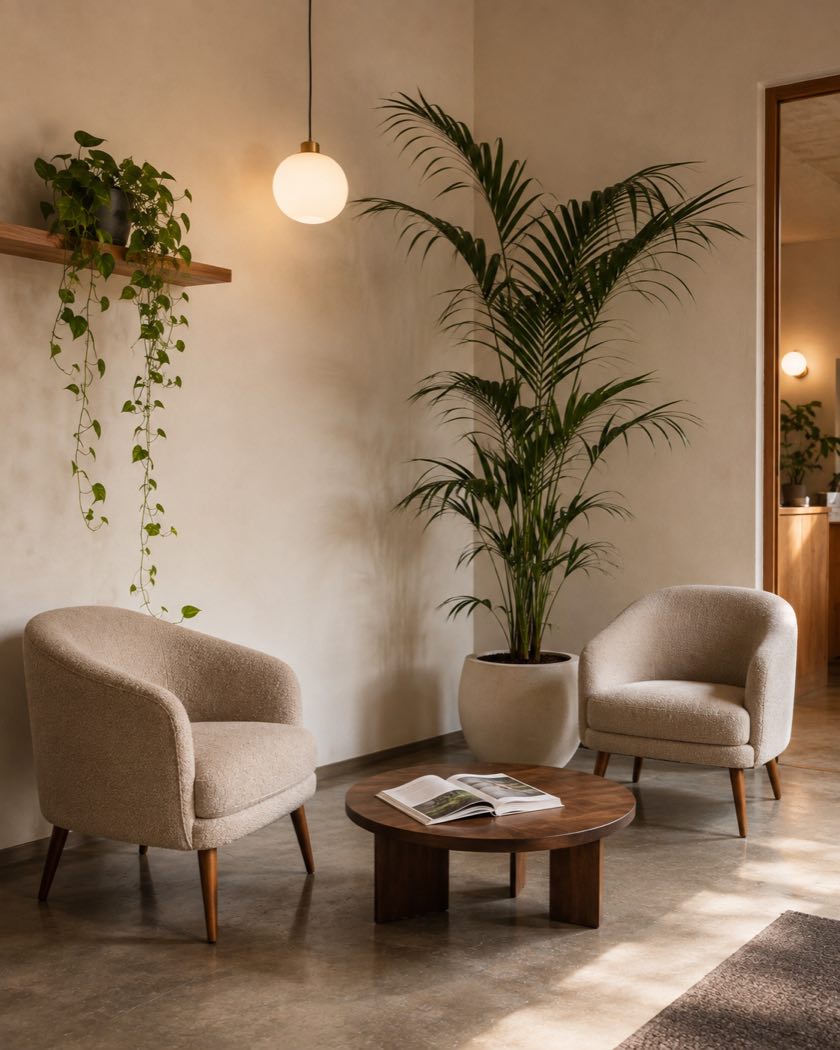
We've spent a fair amount of this journal explaining what plants don't do. It's only fair to be equally specific about what they do, and equally honest about how strong that evidence actually is.
The short version: the effect is on people, not on particles, and it's measurable.
the dental clinic study
In a study published in HortScience, researchers looked at something quite specific: what happens to a patient immediately after dental treatment, depending on the room they recover in.
Thirty patients were randomly assigned to either a room containing indoor plants or an otherwise identical control room, for five minutes following treatment. The measurements weren't self-report alone. Researchers recorded electroencephalography, heart rate variability and skin conductance, alongside the State-Trait Anxiety Inventory.
what they found
A significant increase in alpha wave power in the frontal region, which is associated with a relaxed, wakeful state.
A significant increase in parasympathetic activity, the branch of the autonomic nervous system that governs rest rather than alert.
Thirty patients and five minutes. It's a small, tightly controlled study, and it should be read as one. What makes it useful is that the outcome measures are physiological rather than a questionnaire about whether people liked the room.
the pattern across studies
No single study here is definitive. What's persuasive is that several different research groups, using different methods on different populations, keep landing in the same place.
- Lee et al. (2015), a randomised crossover study, found interaction with indoor plants suppressed sympathetic nervous system activity and lowered diastolic blood pressure relative to a screen-based task. Twenty-four young men, and the task was actively transplanting a plant rather than sitting near one.
- Nieuwenhuis et al. (2014) ran three field experiments in real offices and measured a roughly 15 percent productivity increase after adding plants to bare workspaces, along with higher satisfaction and self-reported concentration.
- Ulrich (1984) found surgical patients with a window view of trees had shorter hospital stays and needed fewer strong painkillers than matched patients facing a brick wall.
Different rooms, different decades, different instruments. The direction doesn't move.
the measurements are of people. that's the whole finding.
where it stops
Being precise about this is the point of the piece.
None of this says plants cure anything. None of it supports a claim about air quality, immunity, or toxins. Several of the studies are small, some are field experiments where confounds are hard to eliminate entirely, and the Lee study in particular is regularly cited as though it showed something about passive exposure when it examined active handling.
What the body of work supports is a modest, repeatable claim: people in rooms with living things in them measure calmer and report the space as better. That's it. It happens to be enough.
why this is the argument we make
Because it's the one we can defend when a practice owner pushes back, and because it maps onto what the person is actually buying.
Nobody puts plants in a waiting room because they've read the autonomic nervous system literature. They do it because they want the room to feel a particular way to the person sitting in it before an appointment they're not looking forward to. The research is simply confirmation that this instinct is measuring something real.
That's a smaller claim than most of this industry makes. It's also the only one we'll put our name to.
sources
- Toyoda, M., et al. Impact of indoor plants on patient recovery in dental clinics: EEG, heart rate variability and skin conductance measures. HortScience. journals.ashs.org
- Lee, M., Lee, J., Park, B., & Miyazaki, Y. (2015). Interaction with indoor plants may reduce psychological and physiological stress. Journal of Physiological Anthropology, 34, 21. jphysiolanthropol.biomedcentral.com
- Nieuwenhuis, M., et al. (2014). The relative benefits of green versus lean office space. Journal of Experimental Psychology: Applied, 20(3), 199–214. pubmed.ncbi.nlm.nih.gov
- Ulrich, R. S. (1984). View through a window may influence recovery from surgery. Science, 224(4647), 420–421. science.org
groundwork
we design it once, then we keep it alive.
real plants for commercial spaces in williamsburg, yorktown, jamestown and newport news. there's an installation at the william & mary entrepreneurship hub you're welcome to walk through.
book a walkthrough