
the journal · the evidence
the tree outside the window.
gallbladder surgery, a brick wall, and the most quietly influential study in building design.
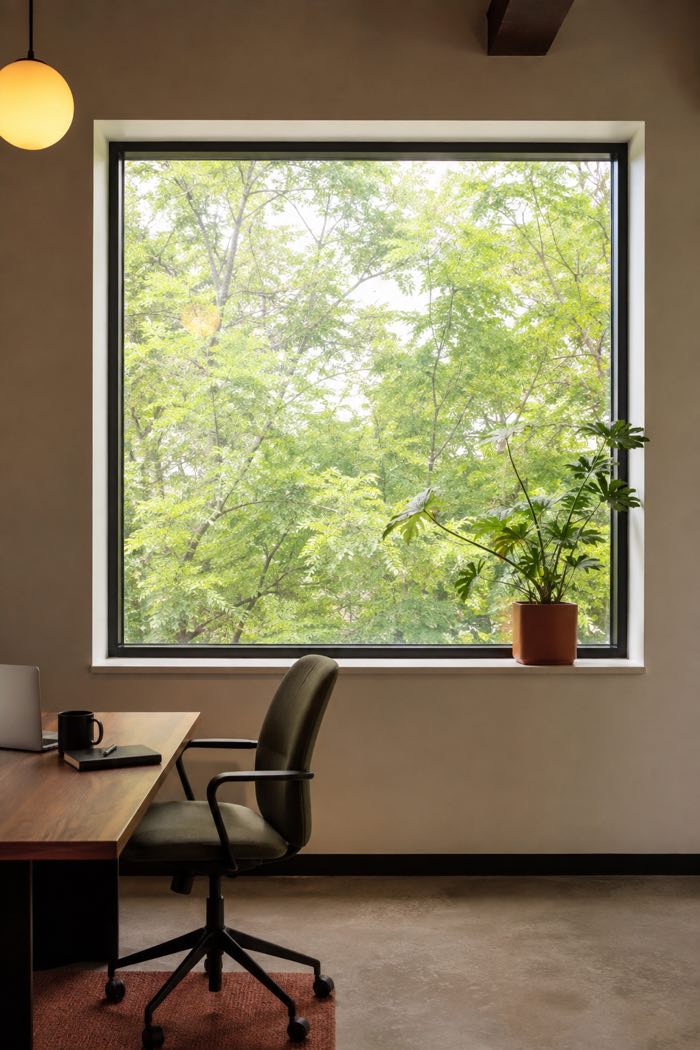
In 1984, a paper appeared in Science that ran barely a page and a half. It's now one of the most cited pieces of research in architecture, and it's the reason a great deal of money gets spent on hospital windows.
The setup is almost too neat.
the study
Roger Ulrich looked at records from a suburban Pennsylvania hospital covering nine years of patients recovering from gallbladder surgery. A wing of that hospital had rooms on both sides of a corridor. The rooms were essentially identical: same size, same layout, same staff, same procedures.
The rooms on one side looked out at a small stand of deciduous trees. The rooms on the other side looked at a brown brick wall.
Patients were assigned to rooms without anyone considering the view, which is what makes this work. Ulrich matched 23 pairs on age, sex, weight, tobacco use, and previous hospitalisation, so the pairs differed as little as possible apart from what was outside the glass.
what he found
Patients with the tree view had shorter postoperative stays.
They took fewer doses of strong analgesics, shifting to milder pain relief earlier.
Nurses recorded fewer negative notes about them, things like "upset and crying" or "needs encouragement."
what to make of it
It's a small study and it's forty years old. Ulrich says as much in the paper. The sample is 46 people recovering from one specific operation in one hospital.
What's happened since is that it's held up. A large literature on restorative environments has grown around it, and the general finding, that visual access to nature reduces measured stress and speeds recovery from it, has been replicated in settings well beyond hospitals.
nobody prescribed anything. the wall just stopped being a wall.
The mechanism people usually reach for is attention restoration: directed attention is effortful and depletes, and natural scenes engage a softer, involuntary kind of attention that lets the effortful system recover. Whether that's the whole explanation is still argued. That the effect exists is not seriously contested.
the uncomfortable version for offices
Most commercial buildings were laid out with the good views going to whoever had the most seniority, and the interior seats going to whoever had the least.
If a view of something living measurably affects how a person recovers from surgery, it's not a stretch to ask what a brick wall does across two thousand working hours a year. That's a harder thing to measure and a more uncomfortable thing to have measured.
what you can do when the window is a wall
Most rooms can't be moved and most views can't be changed. The realistic question is what to do when the view is already bad.
- put the living thing where the sightline is. Not in the corner behind people. In the place their eyes go when they look up from the screen.
- give it enough scale to register. A small pot on a desk isn't performing the same function as something with real presence at eye level across the room.
- prioritise the rooms where people are stuck. A break room or a treatment room where someone sits for an hour beats a corridor they walk through.
- real, obviously. The whole effect rests on the thing being alive. This isn't sentimentality, it's just that the alternative is a plastic object shaped like a leaf, and people are not actually fooled.
This is the closest thing we have to a founding argument. We're not in the business of cleaning your air, and we're straightforward about why we won't claim that. What we're doing is putting living things in the places people look, in rooms that were designed without much thought for what happens when someone glances up.
Ulrich's patients got a stand of trees they never asked for and went home earlier. Most offices can't offer trees. They can usually offer something.
sources
- Ulrich, R. S. (1984). View through a window may influence recovery from surgery. Science, 224(4647), 420–421. science.org
- Ulrich 1984, full text (PDF). researchgate.net
- Nieuwenhuis, M., Knight, C., Postmes, T., & Haslam, S. A. (2014). The relative benefits of green versus lean office space. Journal of Experimental Psychology: Applied, 20(3), 199–214. pubmed.ncbi.nlm.nih.gov
groundwork
we design it once, then we keep it alive.
real plants for commercial spaces in williamsburg, yorktown, jamestown and newport news. there's an installation at the william & mary entrepreneurship hub you're welcome to walk through.
book a walkthrough