
the journal · the evidence
your plants aren't purifying your air.
and the study everyone quotes never said they were.
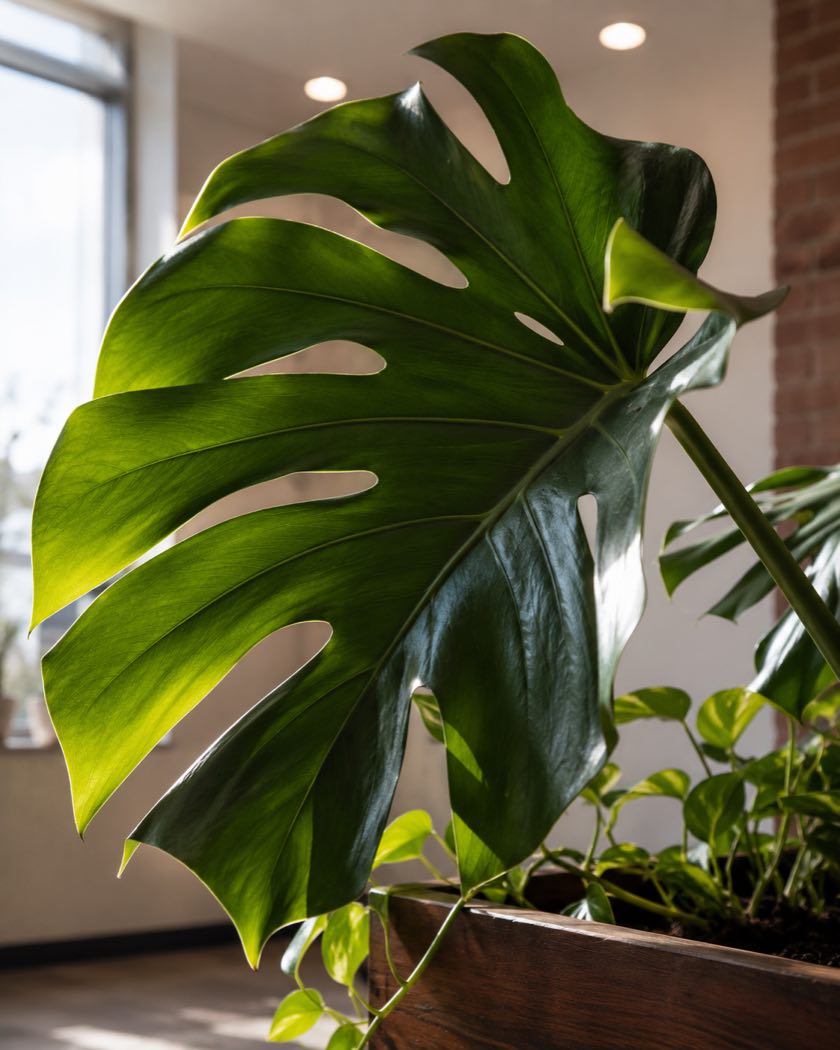
We sell plants. We design installations for offices and clinics, we put the plants in, and we come back to keep them alive. So take what follows in that spirit. It would be considerably easier for us if the thing everybody believes about plants and air were true.
It isn't. And the study that started it never claimed it was.
the study everyone means
When someone tells you plants clean the air, they're citing one paper, usually without knowing its name. In 1989 a researcher named B. C. Wolverton published a report with NASA and the Associated Landscape Contractors of America, asking whether houseplants could scrub volatile organic compounds out of the air in a sealed space station.
The method was straightforward. Individual plants were sealed inside airtight plexiglass chambers, each roughly a cubic metre, about the space a large armchair takes up. Researchers injected a known quantity of formaldehyde, benzene or trichloroethylene, closed the chamber, and measured what was left twenty-four hours later.
The levels dropped. Sometimes dramatically. That result is real, it's been replicated, and nobody serious disputes it.
The problem is what happened to the number afterward.
what a sealed chamber is not
A sealed chamber has no windows, no door, no HVAC, and nobody in it. It was built that way deliberately, because the point was to isolate a single variable and see whether plants metabolise VOCs at all. As an answer to that question, it works.
Your office is the opposite of that chamber in every way that matters. Air moves through it constantly, through vents, gaps, doors and windows, whether or not you ever think about it. That exchange is doing an enormous amount of work before a plant gets anywhere near the problem.
the number nobody quotes
In 2019 two engineers at Drexel University, Bryan Cummings and Michael Waring, went back through the literature and did something the original studies hadn't. They converted every chamber result into a clean air delivery rate, the standard unit used to rate an air purifier, which makes the numbers directly comparable to equipment you can buy.
The median potted plant came out at roughly 0.023 cubic metres per hour.
what that works out to
To match what your building's ordinary air exchange is already doing, you'd need somewhere between 10 and 1,000 plants per square metre of floor space, depending on the room.
A 500 square foot office is about 46 square metres. Take the most generous end of that range and you're still looking at 460 plants. Not 460 across the office. 460 in every square metre.
There's no version of an interior planting scheme that gets you there. There's no version of a building that would survive it.
so why does everyone believe it
Here's the part that actually interests me, and the reason I don't think people repeating this claim are being dishonest.
In 2014 a team led by Marlon Nieuwenhuis ran three field experiments in real working offices in the Netherlands and the UK, comparing bare workspaces against the same spaces with plants added. They found a productivity increase of around 15 percent, along with higher workplace satisfaction and better self-reported concentration.
They also found something stranger. People in the planted offices reported that the air quality was better.
the air was not better. the feeling was real anyway.
Nothing in that study measured particulates or VOCs. What it measured was perception, and perception moved. People walked into a room with living things in it, breathed, and concluded the air had improved. That's a genuine and repeatable human response. It's also, precisely, how a myth survives thirty-five years of nobody checking.
what actually moves the number
- ventilation. Open a window. Get the HVAC serviced and the filters changed on schedule. Find out what your actual air exchange rate is. This is the largest lever in almost every building and it's usually the one nobody has looked at.
- filtration. A HEPA unit rated for the square footage of the room it's in. Sizing matters more than brand.
- source control. Fewer things off-gassing in the first place. New furniture, fresh paint, adhesives and cleaning products all put VOCs into a space. Removing a source beats filtering it out downstream, every time.
then why put plants in a room
Because of what they do to the people in it, which is a different claim with different and better evidence behind it.
There's also a 2015 study in the Journal of Physiological Anthropology that found interaction with indoor plants suppressed sympathetic nervous system activity and lowered diastolic blood pressure compared with a screen-based task. I want to be careful with that one, because it's regularly overstated. It was 24 young men, and the intervention was actively transplanting a plant, not sitting in a room near one.
I could leave that caveat out. Most of this industry would. But the entire point of this piece is what happens when nobody reads past the headline, so it'd be a strange thing to do here.
And then there's the reason that needs no citation. A room with plants in it looks finished. Clients notice within about four seconds of walking in, and they form an opinion about your practice before anyone's said a word to them.
Buy plants for the room and the people in it. Buy an air purifier for the air. They're different products solving different problems, and pretending otherwise has sold a lot of pothos on a promise it was never going to keep.
sources
- Wolverton, B. C., Johnson, A., & Bounds, K. (1989). Interior Landscape Plants for Indoor Air Pollution Abatement. NASA / ALCA. ntrs.nasa.gov
- Cummings, B. E., & Waring, M. S. (2019). Potted plants do not improve indoor air quality. Journal of Exposure Science & Environmental Epidemiology, 30, 253–261. nature.com
- Nieuwenhuis, M., Knight, C., Postmes, T., & Haslam, S. A. (2014). The relative benefits of green versus lean office space. Journal of Experimental Psychology: Applied, 20(3), 199–214. pubmed.ncbi.nlm.nih.gov
- Lee, M., Lee, J., Park, B., & Miyazaki, Y. (2015). Interaction with indoor plants may reduce psychological and physiological stress. Journal of Physiological Anthropology, 34, 21. jphysiolanthropol.biomedcentral.com
groundwork
we design it once, then we keep it alive.
real plants for commercial spaces in williamsburg, yorktown, jamestown and newport news. there's an installation at the william & mary entrepreneurship hub you're welcome to walk through.
book a walkthrough