
the journal · the evidence
plants don't steal your oxygen at night.
where the bedroom myth came from, and what's actually raising the co2 while you sleep.
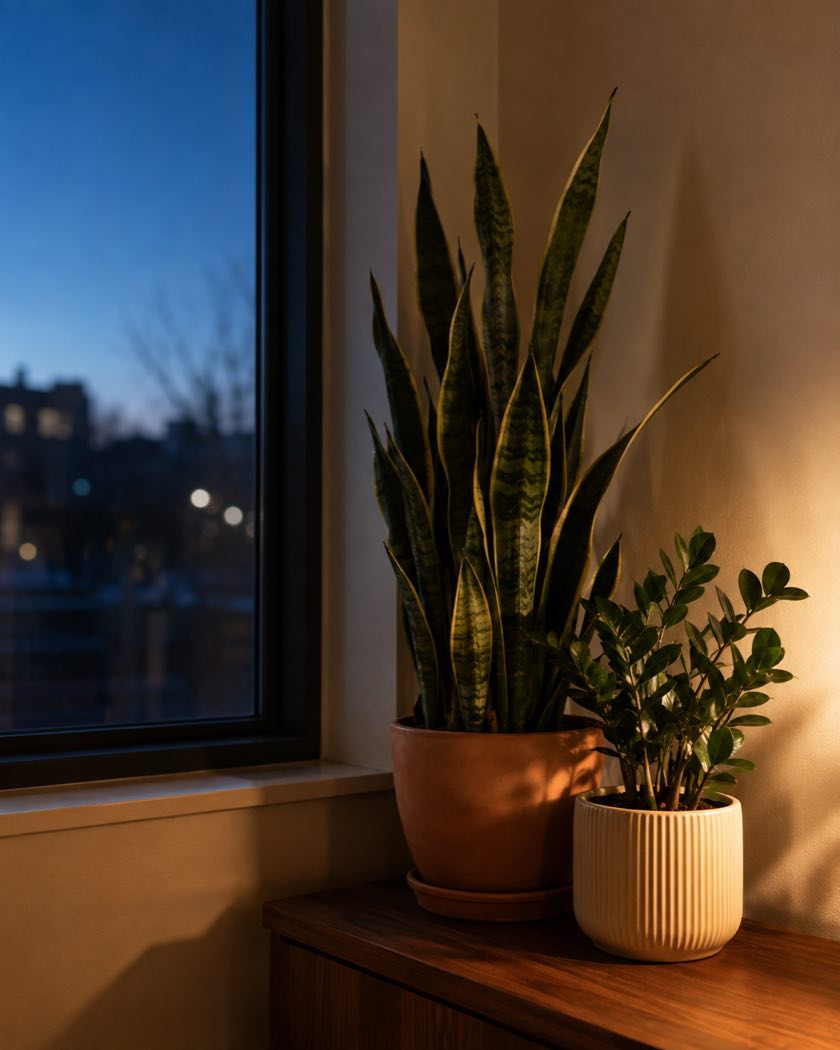
This one has remarkable staying power. Don't keep plants in the bedroom, because at night they stop photosynthesising and start competing with you for oxygen.
The underlying physiology isn't wrong. The scale is wrong by so much that it stops being a consideration at all.
the part that's true
Plants respire continuously, the same as you do: they take in oxygen and release carbon dioxide. During daylight, photosynthesis runs alongside it and consumes far more CO2 than respiration produces, which is why the net effect in daytime is the direction everyone expects.
At night, photosynthesis stops. Respiration continues. So yes, a plant in a dark bedroom is net-producing carbon dioxide.
the part nobody does the arithmetic on
A houseplant's respiration rate is a small fraction of a sleeping human's. You are, biologically, a large warm animal in a small room. The plant is a slow, cool organism with a fraction of your metabolic rate.
the comparison that ends the argument
An adult exhales somewhere around 0.5 to 1 kilogram of carbon dioxide per day.
A typical potted houseplant respires a small fraction of that, and only during the dark hours.
If you sleep next to another person, you have already doubled the room's CO2 production more than a room full of plants would.
Nobody has ever advised removing your partner from the bedroom on air quality grounds.
the plant is not the largest respiring object in your bedroom. you are.
what actually raises bedroom co2
The real answer is dull and worth knowing, because bedroom air quality does affect sleep, just not for the reason the myth suggests.
A closed bedroom with the door shut and the window closed can climb well past 2,000 parts per million overnight, driven entirely by the people in it. Outdoor air is around 420.
A 2016 study by Strøm-Tejsen and colleagues in Indoor Air tested this directly. Participants slept in bedrooms under different ventilation conditions, and better ventilation produced measurably better sleep quality and next-day performance. The intervention that worked was airflow, not the absence of foliage.
the bedroom setup that actually helps
- open the door, or the window, or both. The single largest factor and the cheapest.
- don't seal a small bedroom completely. Some air exchange overnight is doing real work.
- keep it cool. Sleep quality is temperature-sensitive and most bedrooms run warm.
- put the plant wherever you like. Genuinely. This is not a variable.
why we bother debunking this
Because it's the mirror image of the air purification myth, and both errors come from the same habit: taking a real mechanism, ignoring its magnitude, and drawing a confident conclusion.
One of them oversells what we do. The other undersells it. We're not more interested in correcting the one that costs us business than the one that flatters us, which is roughly the standard we're trying to hold ourselves to here.
Keep the plant in the bedroom. Open the door.
sources
- Strøm-Tejsen, P., Zukowska, D., Wargocki, P., & Wyon, D. P. (2016). The effects of bedroom air quality on sleep and next-day performance. Indoor Air, 26(5), 679–686. onlinelibrary.wiley.com
- Taiz, L., & Zeiger, E. Plant Physiology and Development — respiration rates in vascular plants. global.oup.com
groundwork
we design it once, then we keep it alive.
real plants for commercial spaces in williamsburg, yorktown, jamestown and newport news. there's an installation at the william & mary entrepreneurship hub you're welcome to walk through.
book a walkthrough