
the journal · the evidence
the meeting room is making you worse at your job.
what carbon dioxide does to a decision, and why the stuffy room is not in your head.
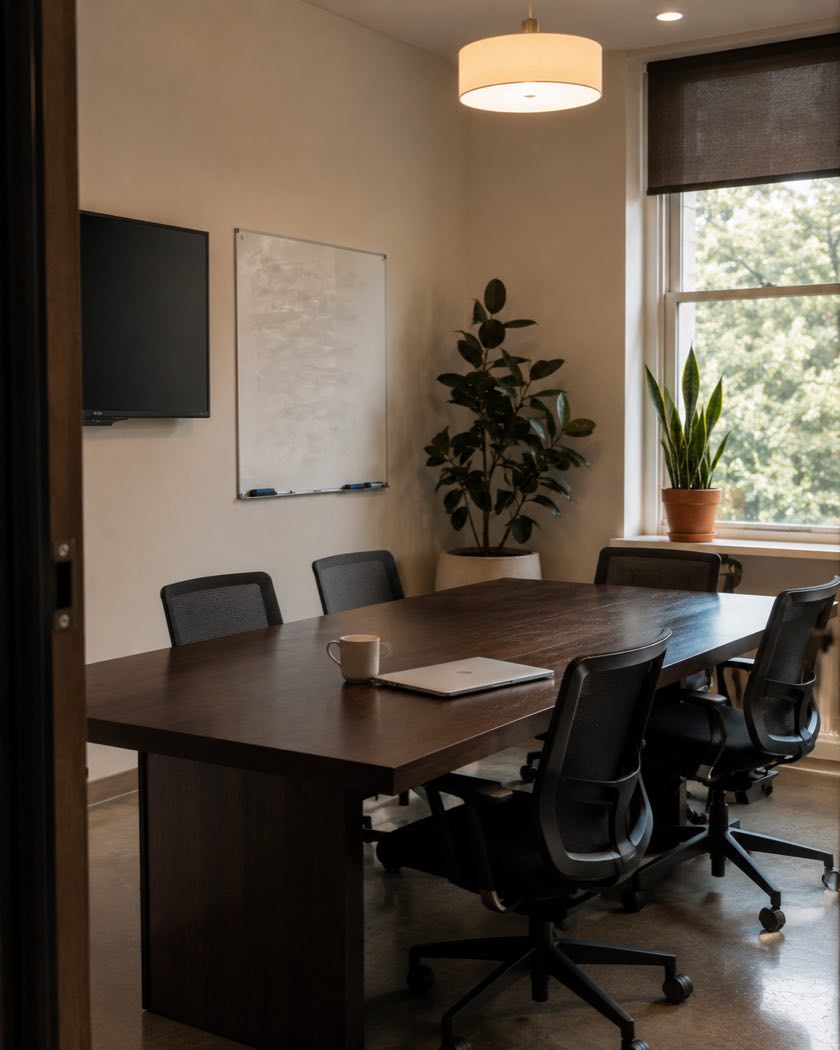
You've been in this room. Six people, a door that's been closed for ninety minutes, and somewhere around the hour mark the whole thing gets heavier. People repeat themselves. Someone suggests picking it up tomorrow.
Everyone blames the meeting. The meeting is not entirely the problem.
what they measured
In 2016 a team at the Harvard T.H. Chan School of Public Health ran what's now known as the COGfx study. They took 24 professionals, architects, designers, engineers and managers, and put them in a controlled office environment for six full working days. Same desks, same work, same people. What changed was the air.
They ran three conditions: a "conventional" office, a "green" office with better ventilation and low-emitting materials, and a "green+" condition where carbon dioxide was held down around 550 parts per million. Each day, participants sat a validated cognitive assessment covering nine domains, including crisis response, information usage and strategy.
the result
Cognitive scores were 61 percent higher on the green building days and 101 percent higher on the green+ days than in the conventional condition.
Not 61 percent higher on one sub-score. Higher across all nine functional domains.
the part that should bother you
Carbon dioxide is not a pollutant in any dramatic sense. It's what you exhale. Outdoor air sits around 420 ppm. A closed meeting room with several people in it climbs past 1,000 ppm within the hour and keeps going, and at those levels the effects on decision-making show up in the data.
you can't smell it. that's the whole problem.
There's no odour, no visible cue, nothing your body flags as a warning. The only symptom is that you get slightly worse at thinking, which is precisely the faculty you'd need in order to notice.
what to actually do
- open the door between meetings. Ten minutes with a door open resets a small room faster than anything else available to you, and it costs nothing.
- find out what your ventilation is doing. Facilities can usually tell you the air changes per hour for a given room. If nobody knows, that's the answer.
- put a CO2 monitor in the worst room. They cost about the price of a nice dinner. Watching the number climb during a meeting is more persuasive than any article, including this one.
- stop scheduling the long ones in the smallest room. The windowless interior room is the one that degrades fastest, and it's usually the one nobody wants to book for anything short.
where plants come into this
Carefully, and not where you'd think.
Plants photosynthesise, which consumes CO2. It's tempting to draw the obvious conclusion, and the honest answer is that the effect in a real room is far too small to manage your ventilation with. A room full of people generates carbon dioxide much faster than a room full of pothos removes it. We wrote about the version of this mistake that involves air purification and this is the same shape of error.
What plants do in a meeting room is different. The research on planted offices shows measurable improvements in reported concentration and satisfaction, and rooms with something living in them get used differently. But if the room is stuffy at 11am, the answer is the door, not a fern.
The reason we bring this up at all is that we get asked to "green up" conference rooms constantly, and the room is often the one with no ventilation and no windows. We'll plant it. We'll also tell you the plants aren't fixing the thing that's actually wrong with it.
sources
- Allen, J. G., MacNaughton, P., Satish, U., Santanam, S., Vallarino, J., & Spengler, J. D. (2016). Associations of cognitive function scores with carbon dioxide, ventilation, and volatile organic compound exposures in office workers. Environmental Health Perspectives, 124(6), 805–812. ncbi.nlm.nih.gov
- The COGfx Study, Harvard T.H. Chan School of Public Health. thecogfxstudy.com
groundwork
we design it once, then we keep it alive.
real plants for commercial spaces in williamsburg, yorktown, jamestown and newport news. there's an installation at the william & mary entrepreneurship hub you're welcome to walk through.
book a walkthrough