
the journal · the environment files
your office is drier than the sahara.
what winter heating does to indoor humidity, and why everyone starts coughing in january.
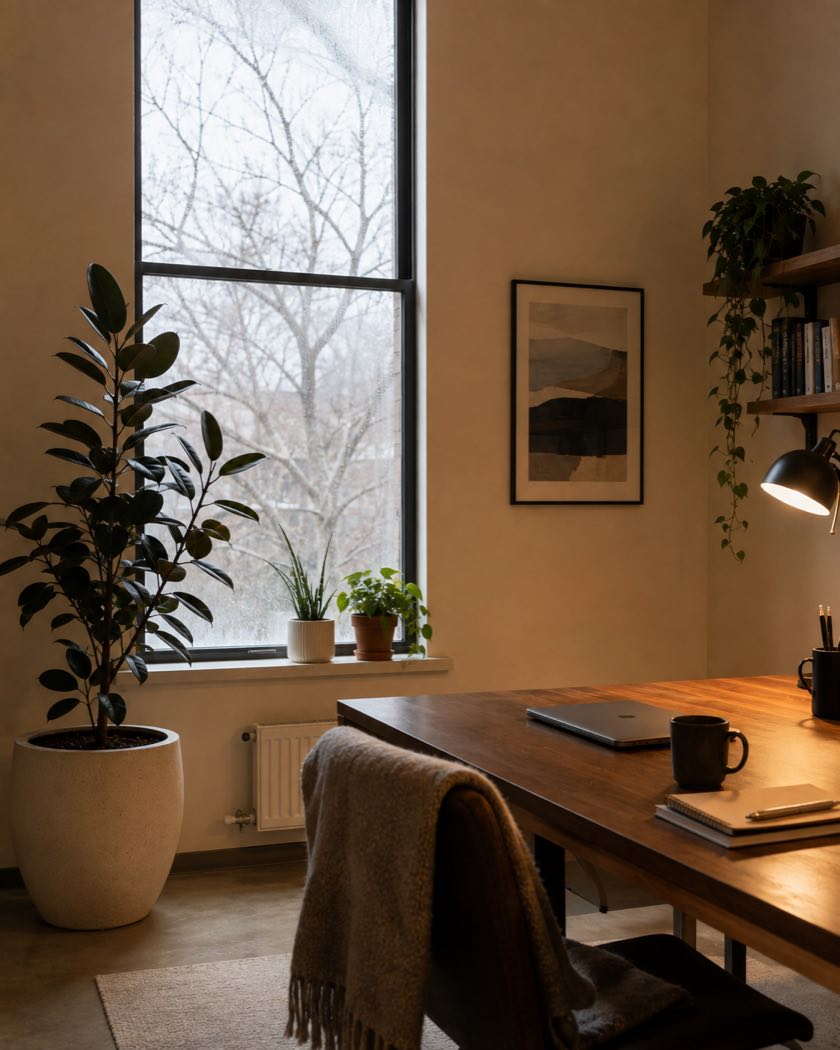
Some time in January, offices start to sound different. There's a cough that goes around and never quite leaves. People keep water bottles closer. Someone's contact lenses stop being comfortable.
The usual explanation is that it's cold and flu season. That's part of it. The other part is that the building has quietly turned into a desert.
the number
Relative humidity is a ratio, not an absolute. It describes how much moisture air is holding compared with how much it could hold at that temperature. Warm air can hold far more. So when a building sucks in cold winter air and heats it to a comfortable indoor temperature, the amount of water in it doesn't change but the amount it could hold goes way up. The ratio collapses.
what that means in practice
Heated buildings in winter routinely sit at 15 to 20 percent relative humidity, and readings below that are common.
The average relative humidity near the surface of the Sahara is around 25 percent.
ASHRAE, the body that writes the standards your HVAC was designed against, recommends 40 to 60 percent.
So the range being recommended is roughly triple what a lot of buildings actually deliver, and the building is drier than the reference desert. That isn't a metaphor anyone is stretching for effect. It's just what the arithmetic does.
why it matters beyond comfort
Below about 30 percent, indoor air is dry enough to dry out the mucous membranes in your nose and throat. Those membranes are the first physical barrier your respiratory system has, and they work considerably better when they're moist.
the cough going round the office is partly the office.
Dry air also does slow damage to the building and everything in it. Wood furniture and instruments shrink and split. Paper curls. Static electricity becomes a daily irritation, which is a symptom, not a coincidence.
what actually raises it
- check it before you fix it. A hygrometer costs almost nothing. Put one in the room people complain about and look at it for a week before spending anything.
- a humidifier sized for the room. Same logic as air purifiers: capacity has to match volume, and an undersized unit in a large open-plan space is decoration.
- ask about the HVAC. Some commercial systems can humidify and simply aren't set to. That's a settings conversation, not a purchase.
- stop over-heating. Every degree you heat the air lowers the relative humidity further. A slightly cooler room is a slightly less parched one.
where plants genuinely help, for once
This is the rare case where I get to make a positive claim about plants and mean it, so let me also be precise about the size of it.
Plants transpire. Water moves up from the soil and leaves through the foliage as vapour, and that vapour goes into the room. This is real, measurable physics, not a wellness claim, and unlike the air purification story it doesn't collapse when you scale it to a real space.
What it won't do is take a room from 18 percent to 45 percent. A grouped planting raises humidity noticeably in its immediate vicinity, which is why a cluster of plants near a desk is more useful than the same plants scattered around a floor plate. Treat it as a local improvement to the air right where somebody sits, not as building services.
If someone tells you a planting scheme will solve a building-wide humidity problem, they're selling you a humidifier that needs watering.
sources
- ASHRAE Standard 55, thermal environmental conditions for human occupancy: 40–60% relative humidity recommended range. ashrae.org
- Condair Group. Health risk in winter: modern buildings often lead to a desert-like environment in living spaces. condairgroup.com
- REHVA Journal. Dry indoor climate: why and how to prepare for the next cold season. rehva.eu
groundwork
we design it once, then we keep it alive.
real plants for commercial spaces in williamsburg, yorktown, jamestown and newport news. there's an installation at the william & mary entrepreneurship hub you're welcome to walk through.
book a walkthrough