
the journal · the environment files
what smells clean isn't clean.
fragrance, ozone, and the chemistry that happens after you spray.
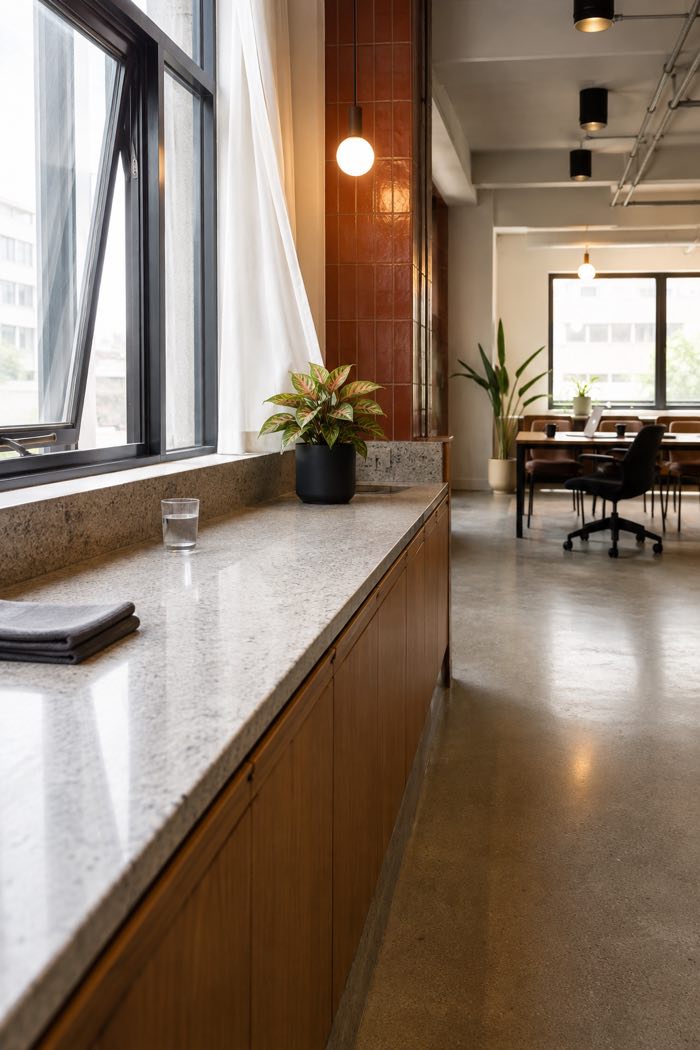
There's a particular smell offices have on Monday morning. Citrus, or pine, or something described on the bottle as "fresh linen." It reads unambiguously as clean.
It isn't a measurement of anything. It's a signal we learned, and the thing producing it is a set of compounds that are now airborne in the room.
what the smell is
The pleasant part of most cleaning products and air fresheners comes from terpenes: limonene for citrus, alpha-pinene for pine. These are volatile organic compounds. That isn't a scare word, it just means they evaporate readily at room temperature, which is exactly why you can smell them from across the room.
On their own, at the concentrations involved, they're not the interesting problem. The interesting problem is what they do next.
the second reaction
Indoor air contains ozone. Some drifts in from outside, more on warm sunny days. Some is generated indoors by printers, photocopiers and any air cleaner that works by ionisation.
Terpenes react with ozone. That reaction produces formaldehyde, ultrafine particles and secondary organic aerosol, none of which were in the bottle and none of which are listed on it. This is well-characterised indoor atmospheric chemistry, not a fringe finding.
the product isn't the pollutant. the product plus the room is.
Research by Anne Steinemann analysing fragranced consumer products has repeatedly found that emitted VOCs are largely undisclosed, because fragrance formulations are protected as trade secrets and "fragrance" is a permissible single ingredient listing. You can read the label completely and still not know what's being released.
what this actually means for an office
Not panic. Proportion.
The dose matters, the ventilation matters, and a cleaner used properly in a well-ventilated space on Friday evening is a different situation from a plug-in diffuser running continuously in a windowless room with a laser printer.
The specific combinations worth avoiding are the ones that put terpenes and ozone in the same room at the same time, continuously, with nowhere for the products to go.
- ventilate while and after cleaning. This is the single highest-value habit and it costs nothing.
- drop the continuous fragrance. Plug-ins, automatic sprayers and reed diffusers in rooms without windows are the worst case, because they never stop emitting.
- be wary of "ionising" or "ozone-generating" air cleaners. Some deliberately produce ozone. That's the ingredient you don't want meeting your citrus cleaner.
- unscented is a real option. The cleaning is done by the surfactant. The smell is marketing.
the honest version of our own pitch
We could tell you plants solve this. They don't, and the reasoning is the same as with air purification: the rates are far too small relative to the volume of a real room.
We bring it up because it belongs to the third item on the only list that does work for indoor air. Ventilation, filtration, and source control. This is source control, and it's the one you can act on this afternoon without buying equipment.
There's also a version of this that's directly our business. We're asked fairly often to add scent to a planting scheme, usually in a reception area. We don't. Partly for the reasons above, partly because a room with living things in it already smells like something, and covering that with synthetic pine is a strange thing to pay for.
sources
- Steinemann, A. (2015). Volatile emissions from common consumer products. Air Quality, Atmosphere & Health, 8, 273–281. link.springer.com
- Nazaroff, W. W., & Weschler, C. J. (2004). Cleaning products and air fresheners: exposure to primary and secondary air pollutants. Atmospheric Environment, 38(18), 2841–2865. sciencedirect.com
- US EPA. Volatile organic compounds' impact on indoor air quality. epa.gov
groundwork
we design it once, then we keep it alive.
real plants for commercial spaces in williamsburg, yorktown, jamestown and newport news. there's an installation at the william & mary entrepreneurship hub you're welcome to walk through.
book a walkthrough