
the journal · the evidence
the window seat is worth 46 minutes of sleep.
what daylight at work does to the night that follows it.
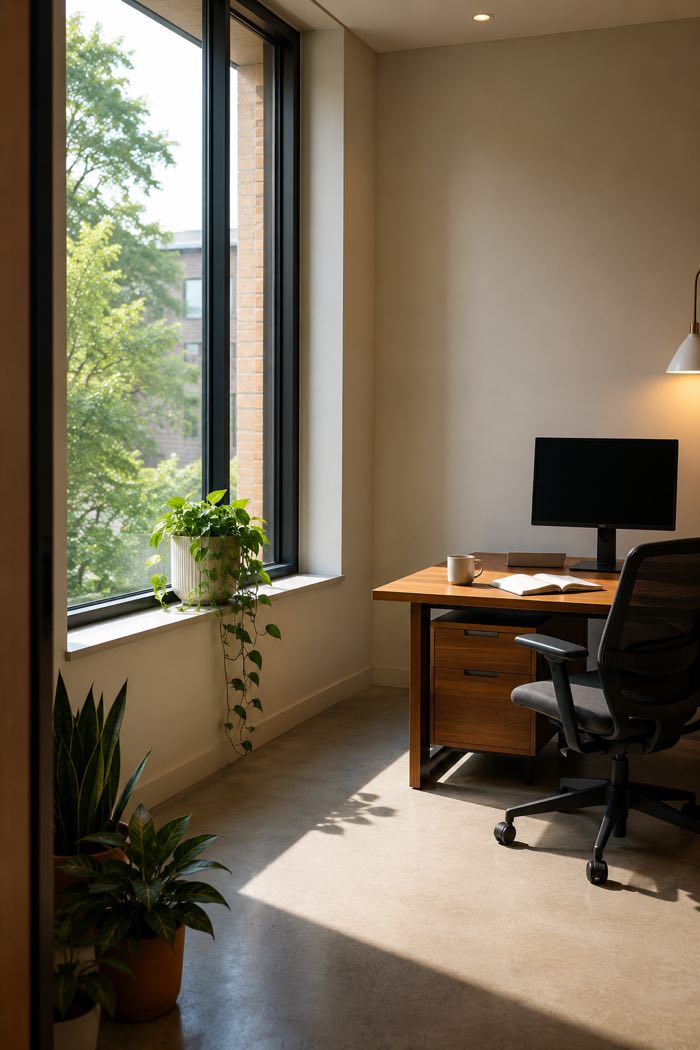
Whoever gets the desk by the window in most offices got it by seniority or luck. It's treated as a small perk, roughly on the level of a better chair.
The measured difference is larger than that.
the study
In 2014 a team led by Mohamed Boubekri at the University of Illinois published a case-control study in the Journal of Clinical Sleep Medicine. They recruited 49 office workers: 27 who worked in windowless environments and 22 whose workplaces had substantial daylight. Everyone wore actigraphs, wrist devices that record light exposure, activity and sleep-wake patterns, so this wasn't only people reporting how they felt.
the finding
Workers with windows received 173 percent more white light exposure during work hours.
They slept an average of 46 minutes more per night.
They also scored better on measures of sleep quality and reported fewer sleep disturbances. It's a pilot study with a small sample and the authors say so. But the direction is consistent with a large body of circadian research, and the actigraphy makes it harder to wave away.
why light at 10am changes sleep at 11pm
Your circadian clock is set primarily by light hitting the eye, and it's far more sensitive to the bright, blue-rich light of daylight than to anything indoors. Getting a strong light signal in the morning is what tells the system when "day" is, which is what determines when melatonin is released roughly fourteen hours later.
indoor lighting is designed for your eyes. daylight is what your clock is reading.
Here's the part most people find surprising: a well-lit office is around 300 to 500 lux. An overcast day outside is around 10,000 lux. Direct sun is 100,000. Your eyes adapt so smoothly that the interior feels perfectly bright, and biologically it's close to darkness.
what to do about it
- go outside before 10am. Ten to fifteen minutes does most of the work. This is free, and it beats every device sold to solve this problem.
- fight for the window desk on the right grounds. Not the view. The light.
- raise the blinds. They're often lowered for a glare problem on one screen at one time of day and then never touched again for years.
- don't put the long-stay desks in the interior. If some seats are windowless, rotate them or give them to the roles that move around the building.
what this has to do with us
More than you'd expect, because it's the same measurement.
The first thing we do in a walkthrough is spend time working out what the light in each room actually does across a day, rather than guessing from the size of the windows. We're doing it to choose species that will survive, since light is the single variable that decides whether a plant lives or slowly gives up.
But the map that comes out of it is the same map that tells you which desks are getting a real circadian signal and which aren't. We've handed that observation to more than one office manager who'd never thought about the north side of the floor plate in those terms.
Plants and people want the same thing from a building, which is more daylight than most buildings are designed to give either of them. The plants just complain more visibly.
sources
- Boubekri, M., Cheung, I. N., Reid, K. J., Wang, C.-H., & Zee, P. C. (2014). Impact of windows and daylight exposure on overall health and sleep quality of office workers: a case-control pilot study. Journal of Clinical Sleep Medicine, 10(6), 603–611. jcsm.aasm.org
- Northwestern Medicine / American Academy of Sleep Medicine summary of the Boubekri findings. sciencedaily.com
groundwork
we design it once, then we keep it alive.
real plants for commercial spaces in williamsburg, yorktown, jamestown and newport news. there's an installation at the william & mary entrepreneurship hub you're welcome to walk through.
book a walkthrough